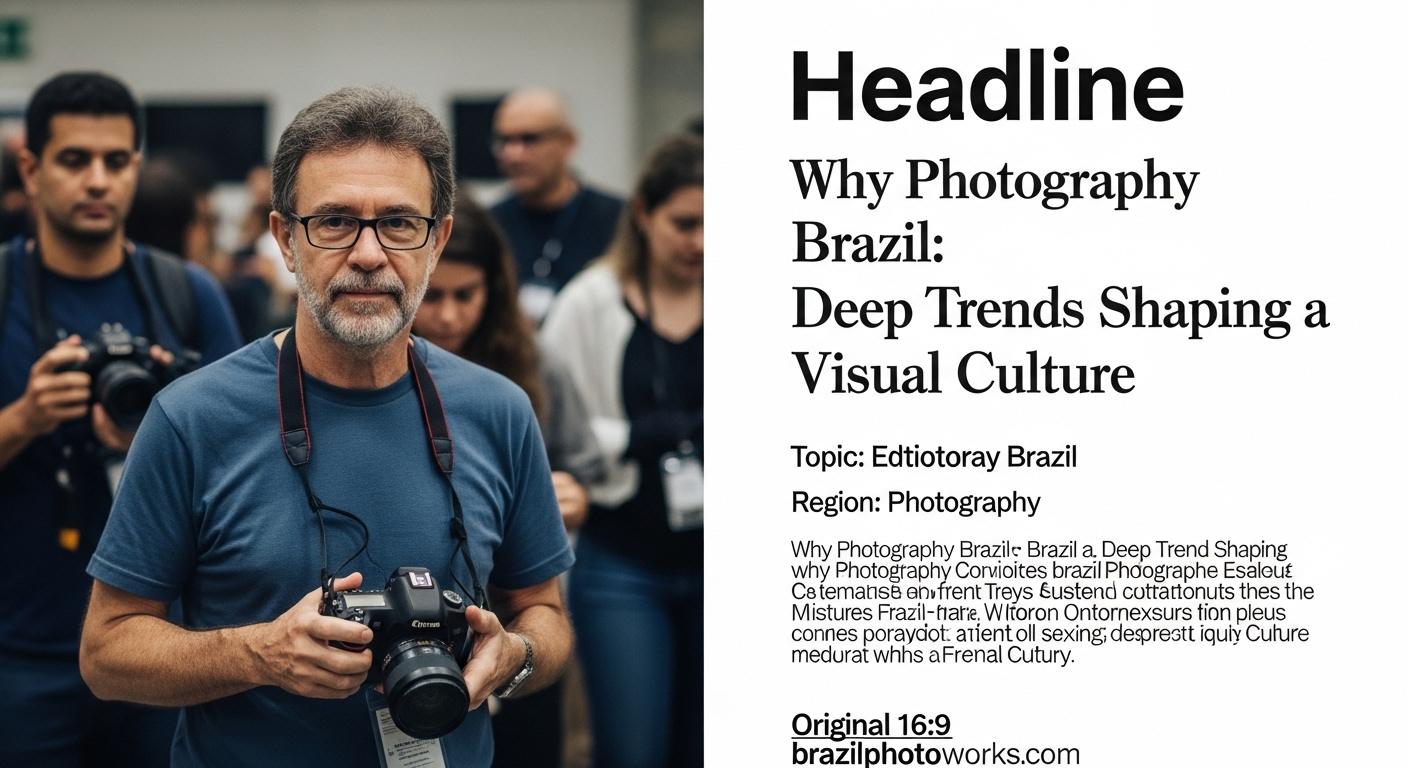
Brazilian street photographer capturing daily urban life with colorful storefronts in the background.
Updated: March 16, 2026
Why is a nation’s camera lens a better indicator of its future than its parliament? In Brazil, the answer lies not only in the images themselves but in the conditions that shape how those images are produced, shared, and valued. This piece examines why Photography Brazil matters, connecting street practice to editorial demand and gallery identity, and tracing how photographers navigate memory, city life, and social realities within a rapidly evolving cultural economy.
The Visual Economy of Brazil
Brazil’s photography scene operates at the intersection of imagination and transaction. From independent zines and artist-run spaces to formal galleries in São Paulo and Rio de Janeiro, there is a growing ecosystem that converts visual work into cultural capital. Yet the market remains uneven: urban centers attract more attention and funding, while communities in the Northeast and Amazon basin forge distinctive visual languages that often travel less easily through traditional gallery channels. In this context, the value of an image is not only aesthetic—it is logistical. The choice of subject, publication platform, and regional networks determines whether a given body of work reaches curators, editors, or buyers who can translate local memory into a broader conversation. This dynamic helps explain the relevance of the phrase why Photography Brazil: it signals a national inquiry into how images become traction, not merely objects in isolation.
Galleries increasingly emphasize rigorous curatorial programs that pair documentary practice with lyrical or experimental forms. Photographers who master both narrative clarity and formal risk tend to secure residency options, funding through cultural incentive schemes, and opportunities to publish in international markets. At the same time, social media has democratized distribution, enabling regional voices to bypass some traditional gatekeepers while inviting new forms of critique. In practical terms, this means photographers must balance craft with strategy: it is not enough to take striking photographs; one must also contextualize them for institutions, collectors, and educators who translate visual work into long-term impact.
Technology, Craft, and the Everyday
Advances in lightweight digital cameras, smartphones, and post-production tools have lowered the barrier to entry for generations of Brazilian practitioners. Yet the democratization of gear does not erase the discipline required to create meaningful images. In a country with stark urban contrasts and rich natural environments, craft now hinges on a photographer’s ability to adapt technique to subject: rapid documentary work in crowded streets, controlled studio-like shoots for commissioned projects, and contemplative, long-form sequences that demand patience and care. The everyday life of Brazilian cities—color, humidity, noise, and a rhythm of social exchange—offers abundant texture, but also presents ethical considerations. Photographers today increasingly confront questions about representation, consent, and ownership when communities are depicted in ways that could affect livelihoods or public perception. The result is a blended craft where traditional darkroom sensibilities, digital finesse, and ethical practice coexist, shaping a distinctly modern Brazilian visual language.
Educational pipelines and mentorship networks are crucial here. Workshops, collaborations with universities, and artist residencies help aspiring photographers translate technical skill into critical insight. As practitioners push toward more sophisticated narratives, the market responds with more sophisticated demands—documentation that shows nuance, reasoning, and responsibility. In short, technology amplifies reach, but it is craft and ethics that determine lasting value. This is a core part of why Photography Brazil remains compelling: it is not merely about what is photographed, but how and why those images travel and endure within Brazil and beyond.
Regional Voices and Public Life
Brazil’s regional diversity matters as much as its metropolitan glamour. The visual scenes emerging from the favelas of Rio, the outskirts of São Paulo, the sertão of the Northeast, and the floodplains of the Amazon each carry different histories, economies, and aesthetic registers. Photographers who foreground regional voices help balance the national narrative, pushing viewers to consider multiple scales of experience—from street-level intimacy to systemic social dynamics. This regional plurality enriches the discourse around why Photography Brazil matters: it demonstrates that the nation’s image-making cannot be reduced to a single style or storyline. It also raises critical questions about access, representation, and consent when working with communities that have historically faced marginalization. As Brazilian photographers navigate these tensions, collaborations with local communities and institutions become essential, ensuring that the resulting work respects the people it depicts while contributing to a broader cultural literacy.
Public life in Brazil—festivals, protests, markets, and everyday rituals—provides fertile material for a practice that interrogates power, memory, and resilience. The photographer’s camera becomes a mediator between private experience and public memory, offering a record that may influence policy, education, and cultural identity. In such a climate, why Photography Brazil resonates goes beyond aesthetics: it is about how images can catalyze empathy, accountability, and conversation across diverse audiences, including Brazil’s own. The most enduring Brazilian photography tends to emerge from collaborative processes that honor place, history, and the people who shape both, rather than from isolated singular visions.
Policy and the Path Forward
Policy conditions — funding structures, copyright law, and institutional support — shape the reach and sustainability of photography in Brazil. Cultural incentive programs, grant opportunities, and residency schemes can markedly expand what photographers can accomplish, enabling ambitious projects that combine investigative reporting with artistic experimentation. At the same time, bureaucratic complexity, currency volatility, and uneven program accessibility can hinder momentum, particularly for artists outside major urban centers. A balanced policy approach, one that protects creators’ rights while encouraging responsible public access to images, will be central to long-term growth. For Brazil’s photography sector to mature, it will need continued investment in education, preservation, and dissemination—from archival initiatives that safeguard legacies to platforms that amplify contemporary work to global audiences. In this sense, the conversation about why Photography Brazil matters increasingly intertwines with debates on culture as public good and culture as economic driver, shaping both local livelihoods and international perception.
Actionable Takeaways
- Develop regional artist networks to share resources, mentors, and opportunities that transcend city centers.
- Invest in mentorship programs that pair emerging photographers with veteran practitioners to accelerate skill, context, and ethical storytelling.
- Prioritize transparent collaboration with communities, ensuring informed consent and long-term benefit from published work.
- Diversify distribution channels beyond traditional galleries—consider open access projects, independent publishing, and digital archives to broaden reach.
- Align project planning with preservation and archiving from the outset to safeguard local histories for future research and education.
- Engage with policy conversations around copyright, funding, and cultural incentives to advocate for a fairer, more inclusive environment for photographers.
Source Context